
What Does Freedom Look Like After 50?
It may have less to do with escaping your life—and more to do with having greater choice within it
When you hear the phrase personal freedom, what comes to mind?
Perhaps you imagine retiring early, traveling whenever you want, paying off every debt, or waking up each morning with absolutely nowhere you have to be.
Maybe your fantasy involves living near the ocean, opening a little shop, writing a book, or finally having enough time to finish a cup of coffee while it is still hot.
Freedom can certainly include big dreams.
But after 50, freedom often becomes less about escaping ordinary life and more about having greater choice within it.
It might mean having enough control over your schedule to attend an exercise class on Tuesday morning. It could mean declining an obligation without spending the rest of the day feeling guilty. It may involve changing how you work, simplifying your home, creating a realistic retirement plan, or making room for something you enjoy.
Freedom does not have to mean doing anything you want whenever you want.
For most of us, that is neither realistic nor especially helpful.
We have financial responsibilities, relationships, jobs, health considerations, homes, pets, aging family members, and people who depend on us. Life after 50 may bring new opportunities, but it can also bring complicated responsibilities.
The goal is not to eliminate every obligation.
It is to create enough space, choice, and flexibility that your life feels more like your own.
Your Definition of Freedom Is Allowed to Change
The freedom you wanted at 25 may not be the freedom you want at 55.
When you were younger, freedom may have meant independence, adventure, career opportunities, or enough money to support yourself.
Later, freedom may have involved building a family, owning a home, developing a career, or creating stability.
Now, your priorities may be changing again.
You may want less responsibility for possessions and more money for experiences. You might want meaningful work without allowing that work to consume your life. You may be thinking about retirement—or deciding that traditional retirement does not appeal to you at all.
Perhaps you want more time for your health, marriage, friendships, creativity, travel, community, or grandchildren.
You may simply want to stop rushing.
Changing your definition of freedom does not mean you chose incorrectly before. It means you have new information, different circumstances, and a clearer understanding of what matters to you now.
The life you worked hard to create may have served you well.
You are still allowed to ask whether it continues to fit.
Start With the Moments When You Already Feel Free
If you are unsure what freedom means to you, think about the times when you feel most like yourself.
When do you lose track of time?
When does your body seem to relax?
When do you feel curious, engaged, peaceful, or energized?
Perhaps you feel free while driving with the windows down and your favorite music playing. Maybe it happens when you are knitting, swimming, gardening, writing, traveling, cooking, walking, or laughing with someone who knows you well.
You may feel free in a quiet house, a lively gathering, a hotel room, a library, a concert, a classroom, or a place where no one needs anything from you for an hour.
These moments contain clues.
They may reveal that what you want is not an entirely different life. You may simply need more creativity, solitude, movement, connection, novelty, or rest within the life you already have.
Five Kinds of Freedom That May Matter After 50
Freedom is not one enormous achievement you either possess or do not.
You may have considerable freedom in one part of your life and very little in another. You might love your home but feel trapped by your schedule. You may have control over your time but feel anxious about money.
Looking at freedom in separate areas can help you identify where a small change would matter most.
1. Freedom With Your Time
Time freedom does not require an empty calendar.
It means having some authority over how your time is used.
After years of working, caregiving, managing a household, and responding to other people’s needs, you may have become the person everyone assumes will handle whatever appears next.
Your schedule fills with meetings, appointments, errands, favors, family obligations, and tasks that somehow became your responsibility.
Eventually, your time may stop feeling like it belongs to you.
Greater time freedom might mean:
Leaving one evening each week unscheduled
Protecting time for exercise or medical appointments
Declining responsibilities you no longer want
Sharing household labor more equitably
Reducing the number of groups or committees you serve
Taking your vacation time instead of continually postponing it
Creating a regular block of time for a hobby
Becoming less immediately available to everyone
Letting something be good enough instead of perfect
You may not be able to control every hour of your day.
But even one regularly protected hour can begin changing your relationship with time.
Ask yourself:
Which parts of my schedule reflect my actual priorities—and which parts remain there because I have never reconsidered them?
2. Financial Freedom
Financial freedom is often depicted as enormous wealth, early retirement, and never needing to look at a price tag.
That version may be appealing, but it is not the only definition.
Financial freedom can also mean having greater stability and more choices.
It might look like:
Understanding where your money goes
Reducing debt
Building an emergency fund gradually
Preparing more intentionally for retirement
Spending less on things you do not value
Having honest conversations about money
Creating room in the budget for experiences you enjoy
Knowing what you can afford before making a major change
Feeling more capable of responding to an unexpected expense
Asking a qualified professional for help when you need it
Money cannot remove every uncertainty. However, greater financial clarity can reduce the feeling that every decision is being made for you.
You do not have to feel ashamed of earlier financial choices to begin making different ones.
Start with information.
What do you have? What do you owe? What matters most now? What would give you greater security or flexibility over the next few years?
Financial freedom is not about pretending limitations do not exist.
It is about understanding those limitations well enough to make informed choices within them.
3. Freedom in How You Work
Work after 50 can become complicated.
You may still enjoy your profession but feel exhausted by the pace. You might want to continue contributing while carrying less responsibility. Perhaps you are interested in a different career, a side business, remote work, part-time employment, consulting, or phased retirement.
You may also need to keep working longer than you once expected.
Greater freedom at work does not always require marching into the office and dramatically quitting by lunchtime.
It might begin with:
Setting clearer boundaries around your availability
Using the leave you have earned
Updating a skill that gives you more options
Exploring flexible schedules
Asking about remote or hybrid work
Moving into a role with different demands
Testing a business idea before leaving reliable employment
Mentoring others instead of pursuing another promotion
Developing an identity that is not entirely built around your job
Preparing financially for a future change
Sometimes freedom means leaving.
Sometimes it means staying under better conditions.
And sometimes it means recognizing that your job is currently providing something important—income, benefits, security, community, or retirement preparation—even if it is not your life’s great passion.
You do not have to love every Monday to make a wise decision about work.
The more useful question may be:
What combination of income, meaning, flexibility, security, and energy do I need from work during this season?
4. Freedom in Your Home and Lifestyle
A home can provide stability, comfort, and belonging.
It can also require an extraordinary amount of money, maintenance, cleaning, organizing, and emotional energy.
The home and lifestyle you wanted during an earlier chapter may no longer support the life you want now.
You may be thinking about:
Downsizing
Renting instead of owning
Relocating
Moving closer to—or farther from—family
Creating a more accessible home
Reducing maintenance
Decluttering accumulated belongings
Living somewhere with better healthcare or transportation
Creating space for hobbies or guests
Traveling more and owning less
Staying exactly where you are but using the space differently
There is no universally correct after-50 lifestyle.
A large home may be perfect for someone who loves entertaining and hosting family. A small condominium may give someone else the freedom to lock the door and travel. Renting may feel wonderfully flexible to one person and uncomfortably uncertain to another.
The important question is not whether your lifestyle looks impressive.
It is whether it supports the way you want to live.
Ask:
What does my home make easier—and what does it make harder?
You may not need to move. The next step could be clearing one room, repairing something that causes daily frustration, or letting go of belongings that require more from you than they give back.
5. Emotional Freedom
Some of the strongest restrictions in our lives are not visible on a calendar or bank statement.
They are the expectations we carry:
I should always be available.
I should be able to handle this myself.
I am too old to begin again.
I have already invested too much to change direction.
People will think I am selfish.
A good wife, friend, daughter, employee, or mother would say yes.
I should be farther along by now.
It is too late to become someone different.
Emotional freedom does not mean you stop caring about other people.
It means their possible disappointment no longer makes every decision for you.
It can include the freedom to:
Change your mind
Ask for help
Be a beginner
Rest without earning it first
Outgrow a goal
Say no without creating a lengthy defense
Stop maintaining a one-sided relationship
Enjoy something without turning it into a productive project
Make an unconventional choice
Want something different
This kind of freedom often grows slowly.
It may begin when you notice an old expectation and ask:
Is this still true for me—or have I simply repeated it for so long that it feels true?
Freedom Always Includes Tradeoffs
Every form of freedom has a price.
More free time may require earning less, delegating more, lowering a standard, or disappointing someone.
Greater financial security may require postponing a purchase, changing a habit, or confronting numbers you would rather avoid.
Changing how you work could involve additional training, a temporary reduction in income, or a difficult conversation.
Moving somewhere new may offer affordability and adventure while taking you farther from people and places you love.
This does not mean freedom is impossible.
It means freedom is a choice involving priorities.
The goal is not to avoid every tradeoff. It is to choose tradeoffs that support what matters most to you.
Some Restrictions Are Real
Not every limitation can be conquered with a positive attitude and a new planner.
Health conditions, disabilities, finances, caregiving, discrimination, employment requirements, and family circumstances can substantially limit the choices available to someone.
Acknowledging those realities is not negativity.
It is honesty.
The helpful question is not:
“Why haven’t I created complete freedom?”
Try asking:
“Where do I have some choice—and how can I use it?”
You may not be able to change the entire situation. You may be able to change one routine, ask for support, obtain better information, set a boundary, or make one part of the situation easier.
Partial freedom still matters.
Discover What Greater Freedom Could Look Like for You
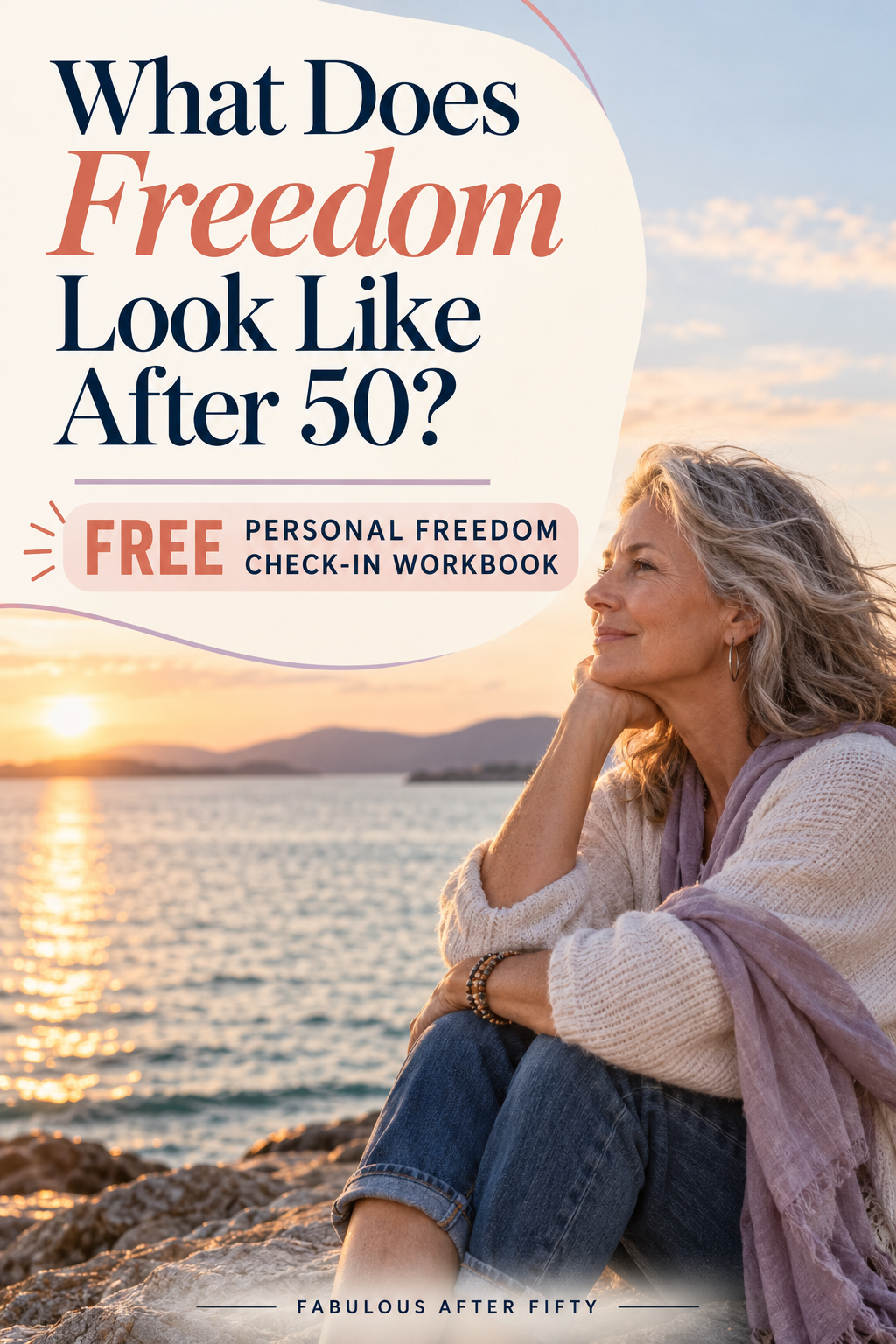
If you are ready to explore where you already have freedom—and where you may be craving more—download the free Personal Freedom Check-In.
This gentle, practical workbook will help you reflect on five areas of freedom, identify the one that matters most in your current season, and choose one small step toward creating more time, choice, flexibility, or breathing room.
You do not need to redesign your entire life.
You only need to notice where one thoughtful change could help your life feel a little more like your own.
Download the Personal Freedom Check-In
You Do Not Need to Escape Your Life
Greater freedom after 50 does not necessarily mean abandoning everything you have built.
It may mean keeping what you value and becoming more intentional about everything else.
You can appreciate your life and still want to change parts of it.
You can love people and create boundaries with them.
You can be responsible and make room for pleasure.
You can prepare for the future and enjoy your life today.
You can value stability and remain open to something new.
Freedom after 50 is not the absence of responsibility.
It is the growing ability to decide which responsibilities, relationships, goals, and routines deserve a place in your next chapter.
You may not have unlimited choices.
But you probably have at least one choice you have not fully claimed yet.
Begin there.