
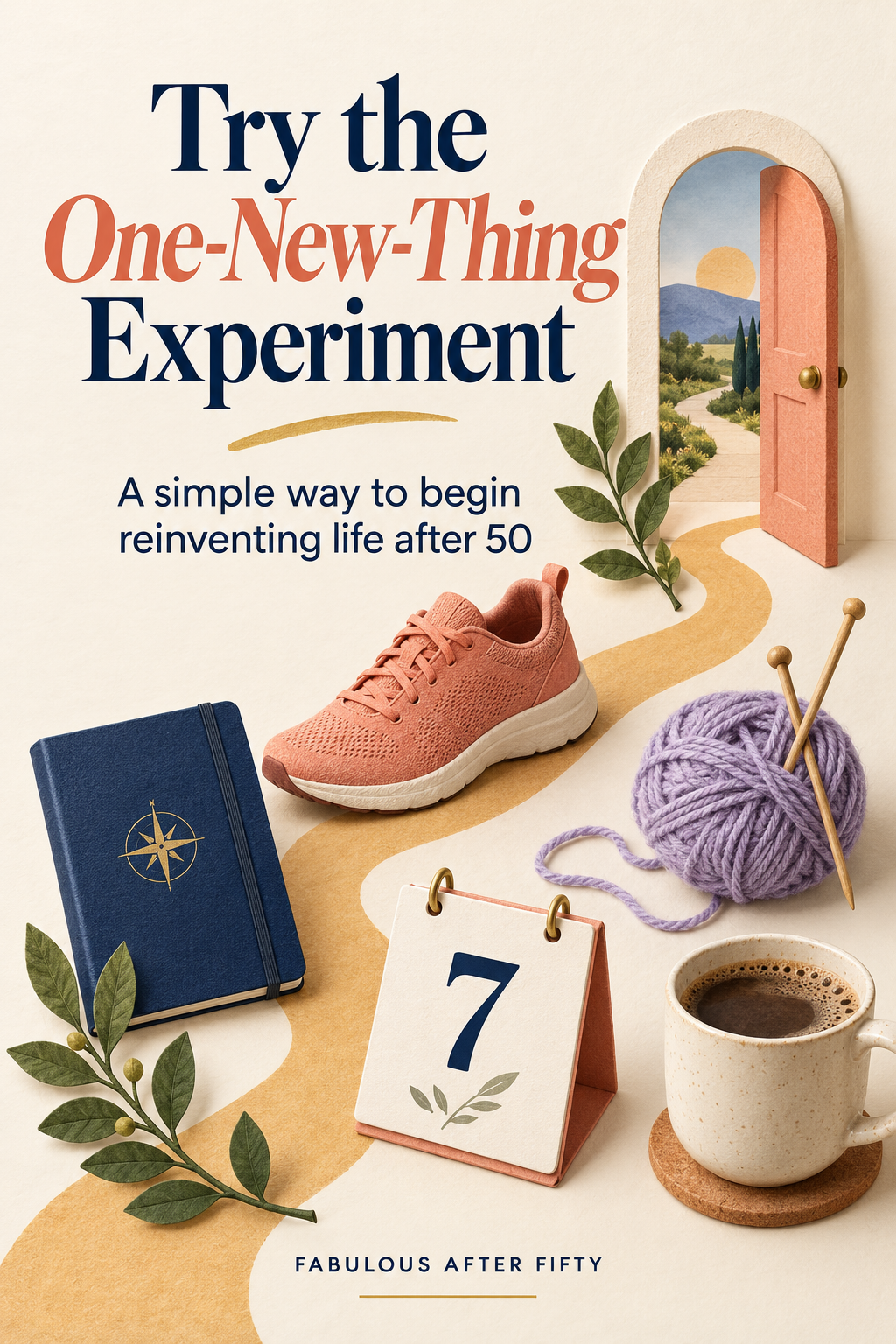
Reinvention After 50: Try the One-New-Thing Experiment
You don’t need a complete life plan—just one small way to explore what might come next
The word reinvention sounds enormous.
It can bring to mind a brand-new career, a new home, a major transformation, or a brave woman boarding a plane with one stylish suitcase and absolutely no concern about who will water the plants.
That version of reinvention can be exciting.
It can also be intimidating.
What if you want something to change but do not know exactly what? What if you cannot afford to make a dramatic move? What if you have responsibilities, health considerations, financial limitations, or people who depend on you?
You do not need to rebuild your entire life.
Try one new thing.
Not forever. Not perfectly. Not because it must become your new identity.
Try it as an experiment.
Why New Experiences Matter After 50
Our lives naturally become more familiar over time.
We know where we shop, what we order, how we spend the weekend, which route we take, and what we are—or are not—“the kind of person” who does.
Familiar routines can be comforting and efficient. They reduce the number of decisions we have to make.
But familiarity can quietly become limitation.
When we stop having new experiences, it becomes easy to assume that the current version of life is the only version available.
One new experience can interrupt that assumption.
It can introduce you to a new person, place, skill, interest, or part of yourself. It can remind you that curiosity did not expire when you turned 50.
Most importantly, it can give you real information about what you might want next.
What Is the One-New-Thing Experiment?
Choose one new thing to try during the next seven days.
It should be:
Small enough to fit into your current life.
Affordable or free.
Safe and realistic for you.
Interesting enough to create a little curiosity.
Low-pressure enough that you can be terrible at it.
Something you are choosing for yourself.
The experiment is not about finding your new passion by next Tuesday.
It is about creating movement.
Your one new thing might take ten minutes, one afternoon, or a few short sessions. It can happen at home, online, in your neighborhood, or somewhere entirely unfamiliar.
The only real requirement is that it gives you a slightly different experience from the one you would ordinarily choose.
Start With the Kind of Change You’re Craving
If you do not know what to try, consider what feels missing from your life.
If you want more creativity
You might:
Take a beginner art or photography lesson.
Visit a yarn, fabric, art, or stationery store.
Write one page of a story.
Make a playlist around a theme.
Try a recipe from a culture you want to learn more about.
Rearrange a small area of your home.
Spend twenty minutes making something without deciding whether it is “good.”
If you want more connection
You might:
Invite someone to coffee.
Attend a community event.
Join an interest-based online group.
Introduce yourself to a neighbor.
Contact someone you genuinely miss.
Try a book club, walking group, choir, class, or volunteer orientation.
Ask a friend a question that leads to a real conversation.
If you want more adventure
You might:
Visit a neighborhood you have never explored.
Try a locally owned restaurant.
Take public transportation somewhere new.
Visit a museum, botanical garden, historic site, or flea market.
Plan a solo afternoon outing.
Take a different route home and stop somewhere interesting.
Research a day trip you could realistically take this season.
If you want better health
You might:
Try a beginner strength, stretching, dance, or water-exercise class.
Walk somewhere more interesting than your usual route.
Prepare one protein-rich breakfast.
Set a bedtime alarm.
Make an appointment you have been postponing.
Test a five-minute morning mobility routine.
Create one environment that makes a healthy choice easier.
Choose an experiment that supports your well-being. Health changes do not need to begin with punishment, exhaustion, or a plan you already dread.
If you want more peace
You might:
Clear one drawer, shelf, or small surface.
Spend ten minutes outside without your phone.
Decline one optional obligation.
Try a short guided meditation.
Create a quieter evening routine.
Unsubscribe from emails that create noise or pressure.
Establish one small boundary around your time.
If you want more purpose
You might:
Attend a volunteer orientation.
Help someone with a skill you already possess.
Research a local cause.
Mentor someone informally.
Learn more about an issue that matters to you.
Join a community meeting.
Consider where your experience could be useful.
Purpose does not always require launching a nonprofit or creating a second career. It can begin with making one meaningful contribution.
Make It Small Enough to Actually Do
A useful experiment is specific.
“Become more adventurous” is not an experiment.
“Visit the farmers market across town on Saturday morning” is.
“Find a new hobby” is not an experiment.
“Attend the free beginner knitting group at the library” is.
“Get healthier” is not an experiment.
“Take a fifteen-minute walk after dinner three times this week” is.
Small does not mean insignificant. It means testable.
A small experiment allows you to take action before you have figured out the entire future.
Use the Ten-Percent-New Rule
Trying something completely unfamiliar can feel overwhelming. Instead, make your regular life about ten percent new.
Order your familiar coffee at a café you have never visited.
Invite a new person to join an activity you already enjoy.
Read a book from a different section of the library.
Take your usual walk in a different location.
Use a skill you already possess in a new setting.
Ten percent new gives you enough familiarity to feel grounded and enough novelty to feel engaged.
You do not need to become fearless.
You only need to become slightly more curious than comfortable.
Expect the Awkward Part
New experiences often include an awkward stage.
You may not know where to park, what to wear, how the equipment works, or whether everyone else already knows one another.
You may feel clumsy, slow, self-conscious, or tempted to decide within three minutes that this was a terrible idea.
That discomfort is not evidence that you do not belong.
It is evidence that the experience is new.
Before you begin, give yourself a sentence to use when awkwardness appears:
“I am allowed to be a beginner.”
“I do not have to impress anyone.”
“This is an experiment, not an audition.”
“I can stay curious for twenty more minutes.”
“I came here to learn, not to perform.”
“I can leave after I have given it a fair chance.”
Being new at something is not a character flaw.
It is how expansion feels at the beginning.
Don’t Demand That It Become Productive
Many of us have learned to evaluate an activity by its usefulness.
Could this become a side business?
Will this improve my health?
Can I make something impressive?
Does this help anyone?
Is it worth the time?
Those questions are not always necessary.
You are allowed to try something because it looks interesting.
You are allowed to enjoy a hobby without mastering it, teaching it, selling it, or creating a social-media account about it.
Pleasure, play, curiosity, and delight are legitimate reasons to spend some of your time.
Your new thing does not need to earn its place in your life.
Ask Three Questions Afterward
After you complete the experiment, do not evaluate it only as a success or failure.
Ask:
1. What did I enjoy?
Be specific. Perhaps you did not enjoy the class, but you liked being around creative people. Maybe the outing was too crowded, but you loved exploring somewhere new.
2. What did I learn?
You may discover that you prefer morning activities, need a slower pace, want more social interaction, or enjoy learning independently.
3. What do I want to do next?
Your answer might be:
Try it again.
Try a different version.
Learn more.
Invite someone next time.
Continue, but make it easier.
Decide it is not for me.
Choose an entirely different experiment.
All of these are valid results.
An experiment that tells you what you do not want has still given you useful information.
Let One New Thing Lead to Another
Reinvention rarely arrives as one grand revelation.
It develops through a series of choices.
One class leads to a hobby. One hobby introduces you to a friend. One conversation reveals an opportunity. One cleared-out room makes space for a creative practice. One short trip helps you imagine a different retirement. One healthier routine gives you the energy to pursue something else.
You cannot always see the full path from the first step.
Fortunately, you do not need to.
Your Seven-Day Invitation
Choose one new thing you can try within the next seven days.
Write down:
What I will try:
When I will do it:
What I need to prepare:
What might prevent me from doing it:
How I can make it easier:
Who I might invite, if anyone:
Keep the experiment small and specific.
Then put it on the calendar.
Not on the imaginary future calendar where you have unlimited energy, extra money, an empty inbox, and a perfectly organized home.
Put it on the calendar you actually use.
Your Life Does Not Have to Change Overnight
You do not have to know what you want to do for the next twenty years.
You do not need to select a new identity, develop a master plan, or transform every area of your life at once.
You only need to create one small opening for something different.
One new routine.
One class.
One conversation.
One cleared-out drawer.
One afternoon somewhere you have never been.
One unexpected yes.
Your next chapter may not announce itself with fireworks and a dramatic soundtrack.
It may begin quietly—with one new thing that helps you remember how many possibilities are still available to you.